THE CORTEX / PRODUCT ARCHITECTURE

Intelligence with
a chain of evidence.

Six connected modules turn fragmented observations into reviewable decisions. Each preserves the context the next stage needs.

01 / THE SYSTEM

The handoff is part
of the intelligence.

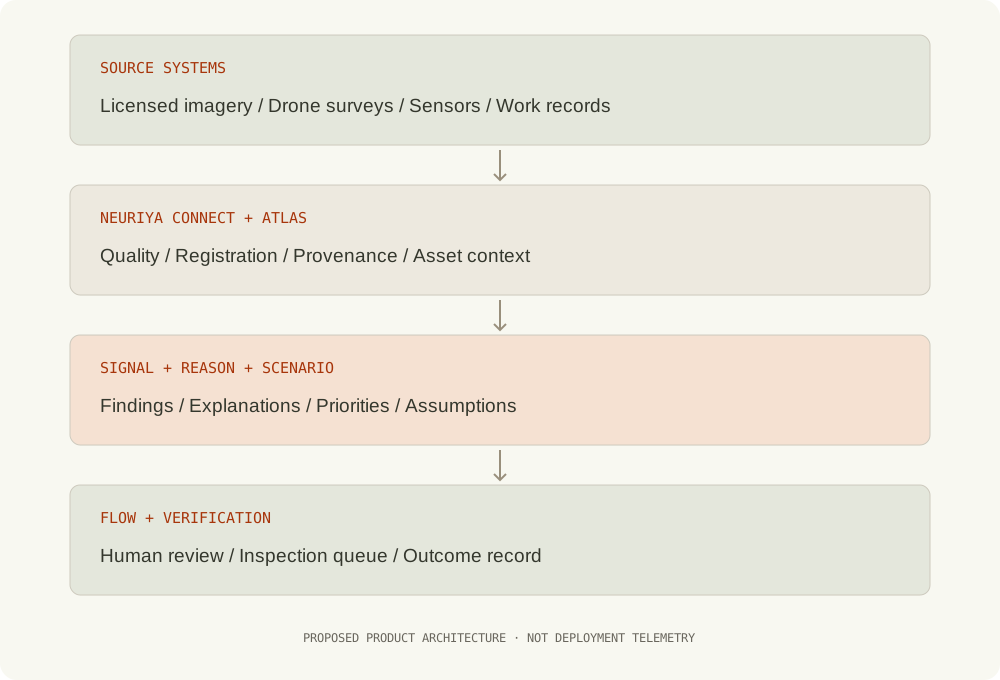
Neuriya’s proposed architecture connects source systems to operational outcomes through a common asset and evidence model.

Data quality comes before detection. Evidence comes before recommendations. Human ownership comes before consequential action. Confirmed results feed back into future evaluation.

  • A source record travels with every finding.
  • A recommendation keeps its assumptions.
  • A task retains the evidence that justified it.
Proposed architecture: source systems, Connect and Atlas, Signal Reason and Scenario, then Flow and verification.
02 / CONNECT + ATLAS

Good decisions begin
with a sound foundation.

01 / CONNECT

Respect the input.

Supported inputs would be registered with their measurement type, date, resolution, ownership, and permitted use. Quality gates would flag missing fields and unsuitable observations before processing.

  • Check cloud, shadow, missing values, and coverage where relevant.
  • Align timestamps and coordinates without concealing resampling.
  • Preserve source licenses and derived-use restrictions.
  • Reject incompatible data rather than imply universal support.
02 / ATLAS

Keep the asset in view.

The operational asset model links a portfolio to sites, equipment, findings, inspections, and results. An observation becomes useful when its relationship to the operation is clear.

  • Maintain source and asset identifiers across workflow stages.
  • Show observation freshness and historical comparisons.
  • Attach maintenance context and field-review notes.
  • Distinguish original evidence from derived interpretation.
Data availability is a product requirement. A faster model cannot replace a missing, outdated, unlicensed, or unsuitable observation.
03 / SIGNAL + REASON

Understand what changed.
Then challenge the explanation.

03 / SIGNAL

A task-specific finding.

Compare observations against an appropriate baseline. Detection quality should be evaluated for the actual sensor, geography, season, and task—not summarized by one universal accuracy number.

  • Define the detection task and acceptable false alarms.
  • Use independent evaluation sets.
  • Identify out-of-distribution inputs.
  • Request better evidence where quality is insufficient.
04 / REASON

An explanation you can inspect.

Reason links the finding to sources, alternative explanations, and the specific questions a reviewer must resolve. Generated narrative must not become an unsupported measurement.

  • Reference the underlying observation.
  • Separate observed, estimated, and human-confirmed facts.
  • Explain why a suggested action follows.
  • Keep uncertainty visible in exports and handoffs.
04 / SCENARIO + FLOW

Compare the options.
Give the next step an owner.

05 / SCENARIO

A plan with visible assumptions.

Explore how budget and evidence priorities affect a proposed inspection queue. The browser demo uses a documented weighted score and a simple budget selection rule. It is decision support, not an optimizer or a guaranteed forecast.

  • See the effect of a changed assumption immediately.
  • Retain the selected observation and calculation settings.
  • Compare the proposed plan with operator constraints.
06 / FLOW

The review is part of the product.

A recommendation can be approved, deferred, or returned for more evidence. A simulated task can then be reviewed without implying the physical issue was resolved.

01

Approve

A person accepts the proposed next step.

02

Inspect

A qualified team gathers field evidence.

03

Verify

A result records whether the finding and intervention held up.

05 / EXPLORE THE HANDOFFS

A system is only useful
when the loop closes.

Start with what the data can support.

Bring observations and operational records together. Check their dates, licensing, resolution, and quality before drawing a conclusion.

Output: a traceable observation, ready for analysis.

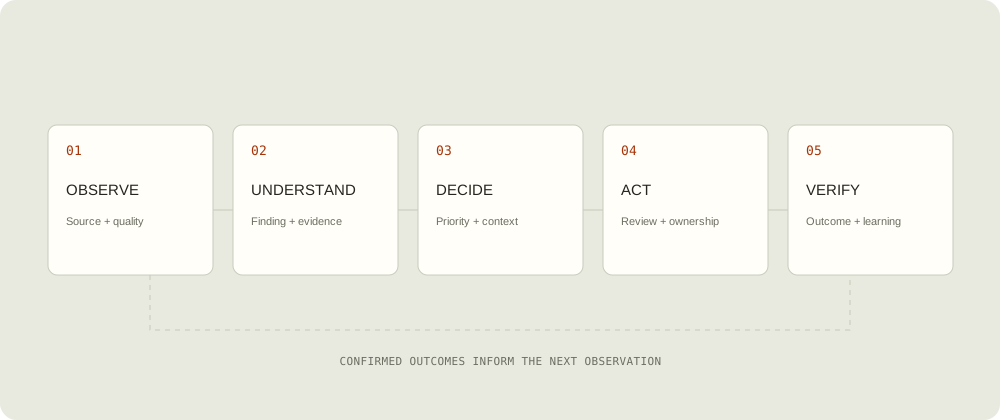
Five connected stages: observe, understand, decide, act, and verify. Confirmed outcomes inform the next observation.
06 / DEPLOYMENT READINESS

Design for the operation
you actually run.

DATA

Source suitability

Confirm imagery access, acceptable latency, quality gates, and permissions before committing to an application.

PEOPLE

Review ownership

Define who investigates, approves, escalates, and verifies. Agree how uncertain findings should be handled.

SYSTEMS

Deployment boundaries

Evaluate identity, retention, regional requirements, integrations, and operating costs as part of a scoped production design.

These modules describe a proposed platform. This package implements the website, local demo, value calculator, and inquiry tools; it does not deploy an AI backend.
YOUR NEXT MOVE

Build a pilot around
one clear decision.

Start with one recurring decision, the data you already have, and a result you can independently verify.

No account required for the demo. No real-world actions are executed.