 Neuriya
What the input contains
The demo distinguishes the synthetic observation from the interpretation attached to it. A source and date travel with the case.
Try the observation-to-action workflow with three synthetic scenarios. Everything runs in your browser. No account, live feed, or production AI connection.
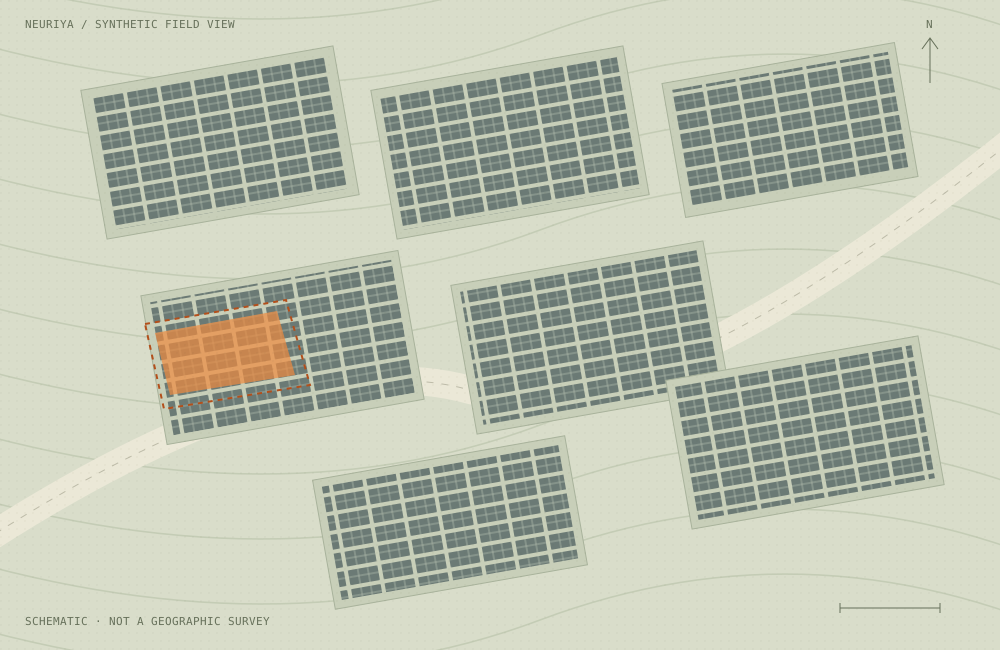
Approve a finding, then create a simulated inspection task.
Synthetic inputs, illustrative scores, and session-only state. Export before leaving. No account, tracking, or live sensor connection.
The demo distinguishes the synthetic observation from the interpretation attached to it. A source and date travel with the case.
Alternative explanations remain visible: reflection, crop stage, registration error, missing records, or unsuitable coverage.
Each scenario states the independent observation, qualified inspection, or field measurement needed before a physical conclusion.
Increasing this setting favors findings with stronger illustrative evidence. The remaining weight is distributed across severity, asset importance, and urgency.
The suggested plan walks through the ranked findings and includes an inspection if it fits the remaining budget. Deferred findings are excluded.
The earlier synthetic observation lowers severity by 18 points and evidence by 12 points. Reviews are tracked separately for each observation.
All factors range from 0 to 100. The result is rounded to the nearest integer. w is the evidence-weight percentage divided by 100. Scores are illustrative, not calibrated probabilities.
Budget selection is a simple greedy rule. It does not guarantee the mathematically optimal set of inspections.
Approval records a simulated reviewer decision. Deferring removes that finding from the current suggested inspection plan.
An approved finding can create one task for the selected scenario and observation. The queue is local to this tab.
This changes the simulated workflow state. It does not verify a physical condition, dispatch a crew, or resolve the underlying asset issue.
Refreshing the page clears the session. Download your findings, plan, or report if you want to retain the current demonstration state.
Download the selected scenario’s settings, scored findings, review states, suggested selection, and simulated task queue.
Download a spreadsheet-friendly table of the current findings with priorities, estimated inspection costs, review status, and task state.
Download a self-contained report containing the selected observation, assumptions, source notes, alternative explanations, and pending verification. Open it and use Print to save a PDF.
No model runs here. Deterministic JavaScript computes scores from local synthetic datasets. The demo illustrates workflow behavior, not AI prediction quality.
This package does not accept imagery uploads. A real pilot would first establish data suitability, licensing, secure transfer, processing requirements, and an evaluation method.
Priority is a weighted combination of several factors. A serious but uncertain finding may deserve investigation. Raising evidence weight helps you see how that tradeoff affects ranking.
No. It is labeled synthetic and contains no real assets. A production workflow would require qualified review, accurate records, and agreed operational safeguards.
Start with one recurring decision, the data you already have, and a result you can independently verify.
No account required for the demo. No real-world actions are executed.